
What's New

2025

MidOpt® Launches NX Series Neutral Density Filters for Broadband Imaging Applications

PALATINE, IL – October 8, 2025 – Midwest Optical Systems (MidOpt®), a global leader in machine vision filters, is proud to announce the release of its new NX Series Neutral Density (ND) Filters. Engineered for broadband light control across the visible (VIS), near-infrared (NIR) and short-wave infrared (SWIR) spectrums (400–2000nm), the NX Series provides smooth, consistent attenuation for today’s most demanding imaging systems.

Developed for CMOS, InGaAs and CQD sensor technologies, NX Series Filters are ideal for applications requiring longer exposure times, reduced depth of field or precise illumination control. With transmission options of 6.25%, 12.5%, 25% and 50%, the series delivers reliable, repeatable performance across a wide range of environments.

“Broadband imaging applications need filters that can deliver uniform attenuation without sacrificing clarity or stability,” says MidOpt® President Mike Giznik. “The NX Series provides engineers and integrators with a versatile, high-quality solution that works seamlessly from the visible into the short-wave infrared spectrum.”Key Features of the NX Series

  • Spectrally Flat Performance: Absorptive coating, color-neutral transmission from 400–2000nm
  • Broad Range of Optical Densities: 0.3 to 1.2 (50% to 6.25% transmission)
  • High-Quality Construction: Precision-polished B270 glass ensures consistent thickness and excellent image quality
  • Durable Coatings: Low-profile gray / black finish minimizes reflections for discreet imaging
  • Flexible Integration: Rugged metal filter mounts with matching male and female threads (M13.5-M105)
  • Custom Formats Available: Sizes up to 165mm square in 1mm or 2mm thickness

The NX Series is also available as custom-cut filters for integration with broadband light sources or large-format optical systems. With their rugged design and exceptional optical performance, NX Series Neutral Density Filters expand the MidOpt® portfolio of innovative solutions for machine vision, inspection, surveillance and scientific imaging.

To learn more about the NX Series or the full line of MidOpt® machine vision filters, visit midopt.com/filters/neutral-density or contact us at info@midopt.com or +1.847.359.3550.
MidOpt® Introduces the BP610 Filter for Enhanced Imaging in Aquatic and Agricultural Applications

PALATINE, IL – August 6, 2025 – Midwest Optical Systems (MidOpt®), a global leader in machine vision filters, is proud to introduce the new BP610 Green-Red Bandpass Filter, engineered to block blue light while transmitting green and red wavelengths. Designed for optimal contrast and clarity, the BP610 is ideal for a wide range of imaging applications, from aquatic to agriculture.

Optimized for Critical Imaging Needs
The BP610 is especially effective in oil spill detection, where water naturally reflects blue light and oil suppresses it. By reducing glare and enhancing contrast, the BP610 helps clearly differentiate clean water from oil-covered areas – ideal for use with multispectral cameras on drones or boats.

In underwater imaging, where blue light scatters rapidly and reduces visibility, the BP610 significantly improves image clarity. When paired with green and red LED lighting, it enables better contrast and detail in murky environments – making it a valuable solution for marine research and underwater drone systems.

For vegetation health and Normalized Difference Vegetation Index (NDVI) imaging, the BP610 improves detection of stressed or dying plants by eliminating blue light scatter, allowing clearer contrast between healthy and unhealthy vegetation.

Built for Performance
The BP610 features proprietary MidOpt® StablEDGE® technology, minimizing angular shifting when placed in front of short focal length lenses; a broad Gaussian passband to match the full output of common LED lighting; double-side polishing for superior optical flatness; and anti-reflection (AR) coating to reduce glare and improve transmission.

BP610 Technical Specifications:

  • Useful Range: 520-690nm
  • Full Width at Half Maximum (FWHM): 190nm
  • Peak Transmission: ≥90%
  • Surface Quality: 40/20
  • Wavelength Tolerance: ±15nm

To learn more about the BP610 or the full line of MidOpt® machine vision filters, visit midopt.com/filters/bp610 or contact us at info@midopt.com or +1.847.359.3550.

Introducing SiLWIR™ Protective Windows for LWIR Thermal Imaging – a Durable, Cost-Effective Alternative to Germanium

PALATINE, IL – [May 1, 2025] – As thermal imaging becomes increasingly important across industries like defense, industrial inspection, medical diagnostics and environmental monitoring, the demand for high-performance optical components in the long-wave infrared (LWIR) range (8-12µm) is growing rapidly. Traditionally, germanium has been the go-to material for LWIR optics, but its high cost and supply limitations present significant challenges – especially for large-scale and cost-sensitive applications.

MidOpt® is proud to introduce SiLWIR: Silicon LWIR Protective Windows for thermal imaging, a rugged, economical alternative that delivers excellent performance in LWIR systems. While silicon has often been overlooked for infrared optics, it offers exceptional value when a pure-grade form is combined with proper coatings, including diamond-like carbon coating and double side anti-reflective (AR) coating.

Why Silicon for LWIR?

  • High LWIR Transmission: Pure-grade silicon with DLC and double-side AR coatings provides outstanding LWIR light transmission, with only a 10% difference in spectral response compared to germanium.
  • Cost-Effective: Silicon is abundant, affordable and benefits from decades of refined semiconductor manufacturing processes, making it ideal for high-volume production.
  • Durable and Tough: With excellent mechanical strength and impact resistance, silicon performs reliably in harsh environments like military and aerospace applications.
  • Efficient Thermal Management: Its superior thermal conductivity helps protect internal system components by efficiently dissipating heat.
  • Readily Available: Mature supply chains and manufacturing capabilities ensure consistent quality, shorter lead times, and stable pricing.

Protective windows are essential to shield internal optical components while maintaining image clarity. With silicon’s unique combination of transparency, toughness and thermal stability, SiLWIR windows provide an optimal balance of performance, durability and cost.

To learn more about MidOpt® SiLWIR and explore how these protective windows can enhance your LWIR imaging systems, visit midopt.com/silwir or contact us at info@midopt.com or +1.847.359.3550.
2023

Midwest Optical Systems Expands Operations with a New Manufacturing Facility in Southeast Wisconsin

Aimed to Boost Production and Meet Rising Demand for Optical Filters

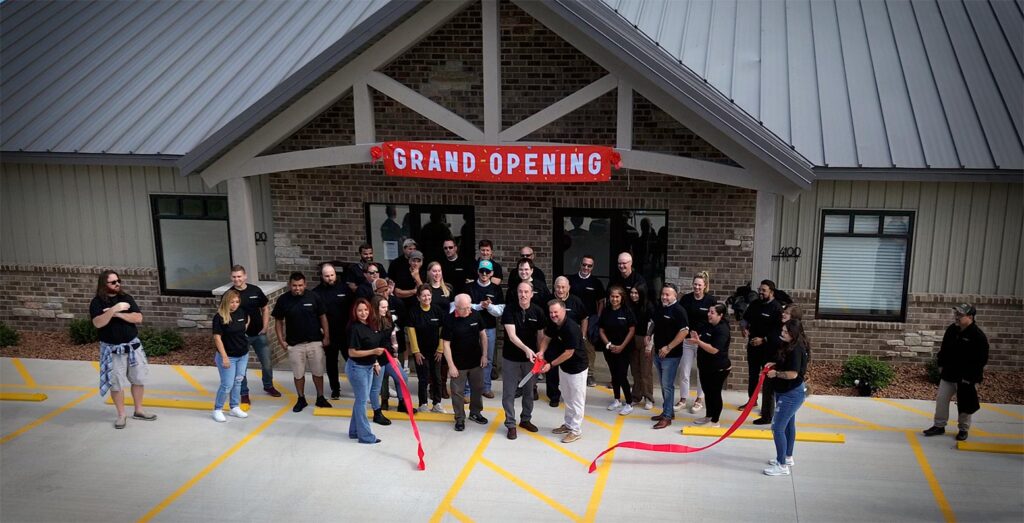
PALATINE, Ill. (October 20, 2023) – Midwest Optical Systems (MidOpt®), an industry leader in machine vision filters and optical solutions, announced the opening of its second location, a manufacturing facility in southeast Wisconsin.

With over three decades of experience and innovation in optical design, fabrication, and inspection, MidOpt® has been at the forefront of providing high-quality products designed specifically for machine vision applications. The new facility is part of the company’s strategic expansion plan to meet the growing demand for their products worldwide.

“We are thrilled about this significant milestone,” said MidOpt® President Mike Giznik. “The new manufacturing facility will not only allow us to increase our production capacity but also enhance our ability to deliver innovative and customized solutions faster.”

The new state-of-the-art facility features advanced machinery and technology that will enhance all facets of production from prototyping to large volume manufacturing runs. This includes the manufacturing of proprietary MidOpt® StablEDGE® Filters, which offer superior wavelength control at any angle – critical as machine vision imaging moves toward more compact inspection layouts.

“Expanding our operations signals our commitment to serving our customers better by ensuring we can meet their needs quickly and efficiently,” Mike added. “We look forward to continuing to produce cutting-edge optical filter technologies that elevate machine vision capabilities across the industry.”

About Midwest Optical Systems

Midwest Optical Systems (MidOpt®) has more than 30 years of experience and innovation in the fields of optical design, fabrication, and inspection. As a worldwide leader in machine vision filters and optical solutions, they are represented in over 30 countries and offer more than 3,000 cutting-edge products. From optical bandpass filters to custom optics, MidOpt® is dedicated to pushing the boundaries of what’s possible in optical technology. For more information, visit midopt.com.

The new MidOpt® North production facility in Delavan, Wisconsin

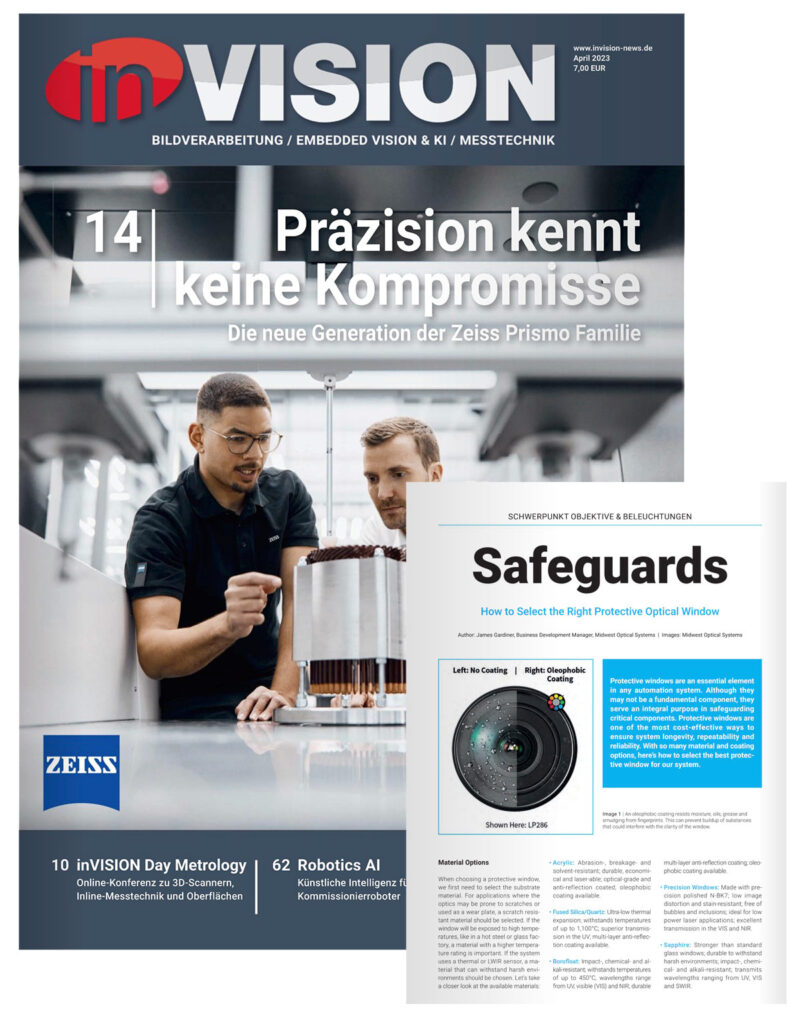
MidOpt published in inVISION, April 2023

Safeguards: How to Select the Right Protective Optical Window

by James Gardiner

When choosing a protective window, we first need to select the substrate material. For applications where the optics may be prone to scratches or used as a wear plate, a scratch resistant material should be selected. If the window will be exposed to high temperatures, like in a hot steel or glass factory, a material with a higher temperature rating is important. If the system uses a thermal or LWIR sensor, a material that can withstand harsh environments should be chosen.

Protective windows are an essential element in any automation system. Although they may not be a fundamental component, they serve an integral purchase in safeguarding critical components. Protective windows are one of the most cost-effective ways to ensure system longevity, repeatability, and reliability. With so many material and coating options, here’s how to select the best protective window for our system.

When choosing a protective window, we first need to select the substrate material. For applications where the optics may be prone to scratches or used as a wear plate, a scratch resistant material should be selected. If the window will be exposed to high temperatures, like in a hot steel or glass factory, a material with a higher temperature rating is important. If the system uses a thermal or LWIR sensor, a material that can withstand harsh environments should be chosen.

Read More See Page 40

› Read Full Article